
Active Warrants in Williamson County
Warrants come from more than one place in the county. Justices of the Peace issue warrants, conduct examining trials, and set bonds. The Magistrate's Office reviews and authorizes arrest warrants and certain search warrants, including blood search warrants, in criminal cases. District and county courts also issue bench warrants and capias orders when a case requires it. The Sheriff's Office then carries out the arrest.
The county magistrates work out of the jail and hold bail hearings seven days a week. You can read about that role on the county Magistrate's Office page.
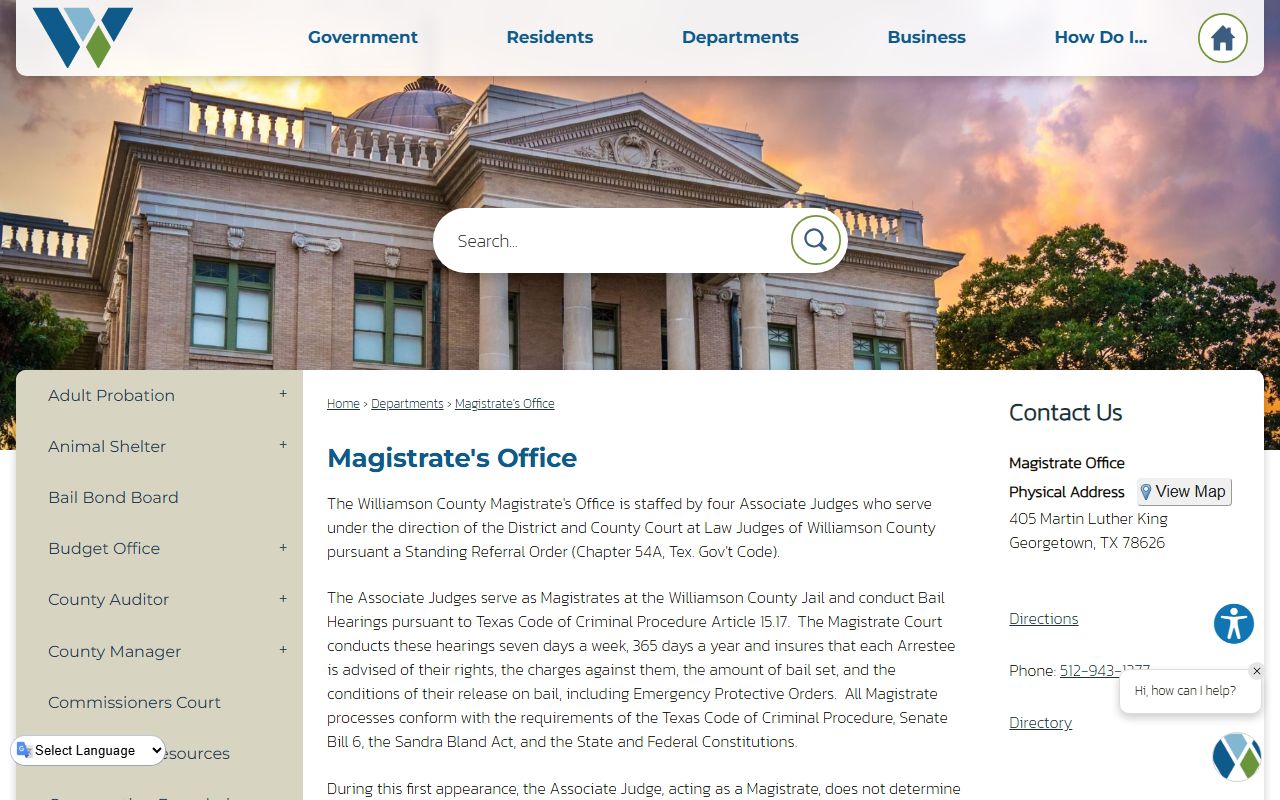
The Magistrate's Office authorizes many warrants, which is why warrant details often trace back to a magistrate's review.
No official countywide active-warrant list was found in the county's main pages. The reliable check is the public court and jail records inquiry, the Justice of the Peace court records, or a direct call to the issuing court or law enforcement.
Types of Warrants in Williamson County
Warrants are not all the same. Some order an arrest, some order a search, and some follow a missed court date or unpaid fine. Knowing the type tells you which court to call and what to expect next.
- Arrest warrant - orders law enforcement to take a named person into custody on a charge.
- Bench warrant - issued by a judge, often after a missed court date or a violation of a court order.
- Search warrant - authorizes a search, including a blood search warrant in some cases, after a magistrate's review.
- Capias / capias pro fine - a custody order; a capias pro fine ties to an unpaid fine in a fine-only case.
How to Search Williamson County Warrants
Start with the county's Public Judicial Records system, the same court and jail lookup used for cases and bookings. The Corrections Bureau page says to search jail records by first and last name or by booking number. You can open the tool from the county Public Judicial Records page. For traffic and Class C warrants, check the matching Justice of the Peace precinct, which keeps its own court records.
- Open the Public Judicial Records system and search by full legal name or booking number.
- Open the case to look for a capias, bench warrant, or active hold and any bond set.
- If the matter is a ticket or Class C case, check the JP precinct that issued the citation, since those warrants live with the precinct.
Williamson County Warrant Search Fields
Warrant searches use the same fields as court and jail lookups. A name search is the common path, and a cause or booking number narrows it. The court filter helps when you know which level issued the order.
| Field Label | Type | Required | Notes |
|---|---|---|---|
| Last Name | Text | Yes | Use the full legal last name. |
| First Name | Text | No | Adds precision to a name search. |
| Case / Cause Number | Text | No | Pulls the case a warrant is tied to. |
| Booking Number | Text | No | Use when the person has already been booked. |
| Court | Dropdown | No | JP, County Court at Law, or District Court. |
What a Williamson County Warrant Record Shows
A warrant result ties a person to a case and a court. It usually names the type of warrant, the charge, and a bond if one is set. The status tells you whether the warrant is still active, served, or recalled. The table below lists the common fields.
| Field | What It Shows |
|---|---|
| Warrant Type | Arrest, bench, capias, capias pro fine, or search warrant. |
| Issuing Court | The JP, County Court at Law, District Court, or magistrate that issued it. |
| Charge / Cause | The offense or case the warrant is tied to. |
| Bond Amount | The bail set, when the court or magistrate has set one. |
| Status | Active, served, recalled, cleared, or closed. |
Note: Sealed warrants, juvenile warrants, and search warrants in an open investigation may not appear in a public search.
What to Do If You Have an Outstanding Warrant
A warrant does not go away on its own. The steps below help you handle it the right way and protect your rights. Do not rely on a caller who demands payment; that is a common scam.
- Verify the warrant through the official court and jail lookup or by calling the court, clerk, or law enforcement directly.
- Identify the issuing court and the case number so you know who to contact.
- Consult an attorney for any criminal, probation, family-violence, or felony warrant before you act.
- For a traffic or JP capias pro fine, call the JP court first to learn your options and whether you must appear.
- Keep written proof that the warrant was recalled or cleared, because online systems can lag.
Important: Talk to a lawyer before you turn yourself in on a criminal or felony warrant, since bond and release conditions are often set at the first appearance.
Bond and Release After a Warrant Arrest
When a person is arrested on a warrant, the booking process leads to a magistrate. The county holds these Article 15.17 hearings at the jail every day of the year. The magistrate advises the person of the charges, sets the bail amount, and lists any conditions of release. The bond set at this stage often shows up on the jail record next to the charge.
Bond can take a few forms. A cash bond pays the full amount to the court. A surety bond uses a licensed bail bond company that charges a fee. A personal recognizance bond, or PR bond, releases a person on a promise to appear without full cash up front, when the court allows it. For a capias pro fine in a fine-only case, the Justice of the Peace court may want payment or a court appearance before it recalls the warrant. The magistrate does not decide guilt and cannot give legal advice.
Williamson County Jury and Warrant Scam Warning
Scam callers target county residents with fake warrant threats. They claim a failure-to-appear jury warrant has issued and demand money to clear it. The District Clerk warns that Williamson County district and county courts will never call a person and ask for money, gift cards, or money orders to clear a jury failure-to-appear warrant. If you get such a call, hang up and verify directly with the court.
Important: No real Williamson County court will demand gift cards or wire payment over the phone to clear a warrant; treat any such call as fraud.
Crime Stoppers and Anonymous Tips
The Sheriff's Office links Crime Stoppers and a way to report a crime from its main page. Anonymous tips can help locate a person with an active warrant, and some tips may qualify for a reward. The Sheriff's Office also lists non-emergency and community contact numbers. You can find these tools on the county Sheriff's Office page. For an emergency or a crime in progress, call 911 instead of using a tip line. The Sheriff's Office also lists a non-emergency line for routine reports that do not need an immediate response.
Restricted Williamson County Warrant Records
Not every warrant is public. Search warrants in an open investigation are often sealed until they are executed and returned. Juvenile warrants follow the strict juvenile record rules. Federal warrants are handled by federal agencies and the U.S. Marshals, not the county jail, unless a person is held locally on a federal hold. When a record is restricted, it will not show in the county's public search.
This is why an empty search result does not always mean there is no warrant. A sealed or very recent order may not appear yet, and systems can lag behind the courthouse. If you have a real reason to believe a warrant exists, the safest move is to call the issuing court or speak with an attorney rather than rely on a blank screen. Do not let a scam caller pressure you into paying based on a warrant you have not verified.
Common Williamson County Warrant Questions
Two questions come up most often when people search for a warrant. Quick answers help you avoid a costly mistake.
Does Williamson County publish an online active-warrant list? The county's main pages do not post a single public most-wanted or active-warrant list. The official way to check is the court and jail records inquiry, the Justice of the Peace court records, or a direct call to the issuing court. A warrant tied to a booking will show in the jail records.
Can I clear a warrant by paying online? Sometimes, but not always. For a traffic or fine-only capias pro fine, the Justice of the Peace court may accept payment or require a court appearance. For an arrest, bench, or felony warrant, call the court and talk to a lawyer first, because bond and conditions are usually set by a magistrate or judge, not online.