
About the Williamson County District Clerk's Office
The District Clerk is an elected office. Lisa David has served as Williamson County District Clerk since her election in November 2006, after starting in the office in 1981. In 2018, the County and District Clerk's Association named her District Clerk of the Year for Texas. The office keeps the official records for the district courts and serves as the county's jury manager.
The District Clerk handles the district-court side of a split clerk system. For marriage, probate, misdemeanor, and official public records, the County Clerk is the right office. You can reach the District Clerk through the county District Clerk page.
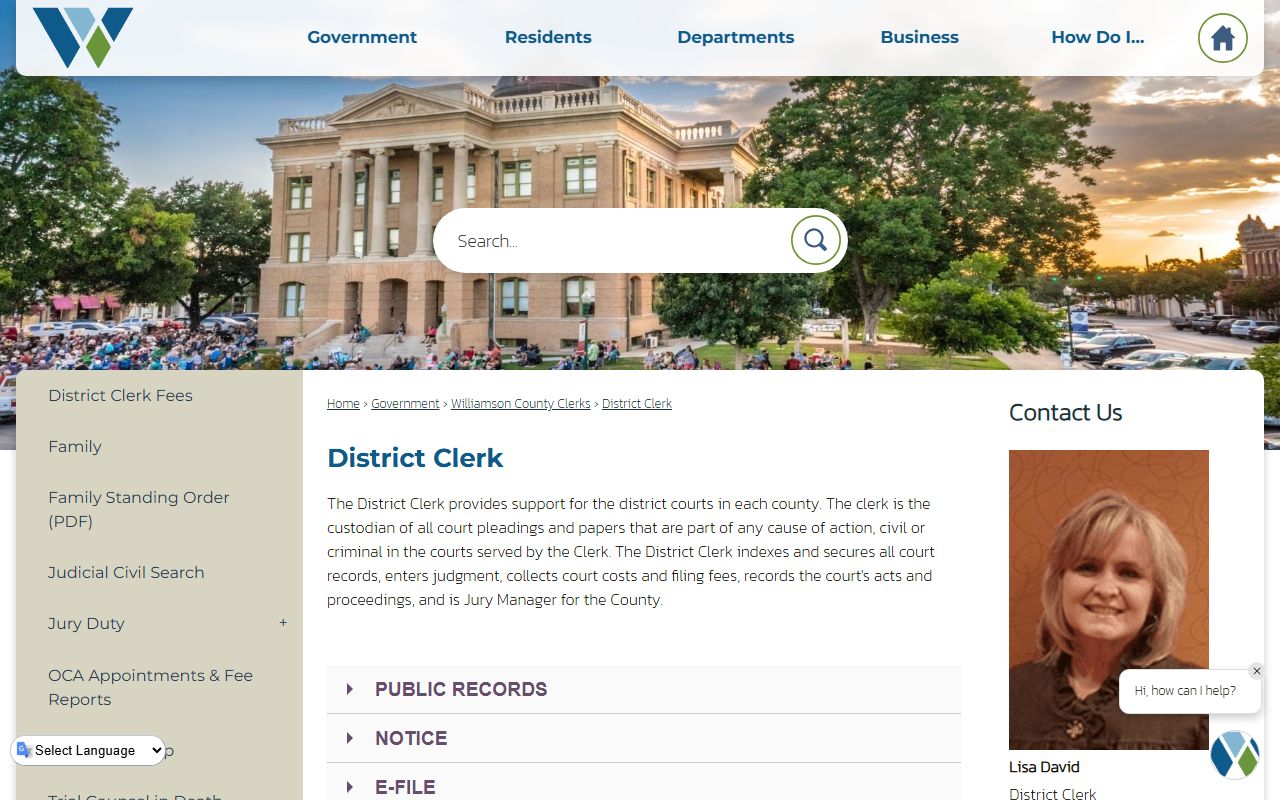
The page explains record requests, e-filing, jury management, and the office's hours and contacts. It is the best starting point before you call or visit, since it lists current submission methods and the record request form.
Williamson County District Clerk
Clerk: Lisa David
405 Martin Luther King St. (P.O. Box 24)
Georgetown, TX 78626
512-943-1212
dcrequest@wilco.org
Mon-Fri 8am-noon, 1pm-5pm (no financial after 4:30pm)
What the District Clerk Does in Williamson County
The District Clerk's duties center on the district courts. The office indexes and secures court records, enters judgments, collects court costs and filing fees, and records the acts of the district courts. It also runs jury service for the county. Public information requests go to the official public-information email, while copy requests go to the District Clerk.
- Keep and index district court pleadings in civil, family, juvenile, and criminal cases.
- Enter judgments and record the proceedings of the district courts.
- Collect court costs and filing fees.
- Serve as the county jury manager.
The office also limits public use of its research areas, so most civil, family, juvenile, and criminal record requests are handled electronically rather than in a walk-in research room. District court cases are also visible on the county's judicial records website. That split between online case lookup and clerk copy requests is the key to using the office well: search the case online, then ask the clerk for the certified document you need.
Jury Service and the Williamson County Jury Manager
The District Clerk serves as the county's jury manager. The office summons jurors, tracks service, and supports the courts during jury weeks. Most people meet the District Clerk for the first time through a jury summons rather than a case.
Jury duty is also a common target for scams. The District Clerk warns that Williamson County district and county courts will never call a person and demand money, gift cards, or money orders to clear a failure-to-appear jury warrant. If you get such a call, hang up and verify directly with the court. A real summons or notice comes in writing, not as a phone demand for payment.
What District Court Records the Clerk Holds
The District Clerk holds the files for cases in the district courts. That is a broad set, since district courts handle the county's most serious and complex matters. Some of these records are open to the public, while others are restricted by statute or court order.
- Felony criminal cases, including charging documents, pleas, judgments, and sentences.
- Civil lawsuits over the lower-court limit, with petitions, motions, orders, and judgments.
- Family cases such as divorce, custody, and support.
- Juvenile and child welfare cases, many of which are restricted from public view.
Sealed, juvenile, expunged, and nondisclosed records will not be released through an ordinary request. The office will not provide a document sealed by order or statute unless the law allows it. If you are a party or attorney who needs a closed file, the court can explain what access the law permits.
How to Request a Certified Copy
A certified copy carries the clerk's seal and is needed for many legal purposes. The District Clerk cannot email certified copies; they are mailed or picked up in person. The steps below walk through a request.
- Identify the case or cause number, or have the party names and an approximate file date.
- Complete the District Clerk record request form, choosing certified or non-certified.
- Submit it by email, fax, mail, or in person, with payment for the copies.
- Allow up to three days, then receive the copy by mail or pick it up in person.
Submit a request by email to dcrequest@wilco.org, by fax to 512-943-1222, in person at 405 Martin Luther King St., or by mail to Attn: DC Records, P.O. Box 24, Georgetown, TX 78627. Non-certified copies may be emailed or faxed. Choose certified only when you truly need an official sealed copy, since it costs the same per page but cannot be delivered by email.
Records Request Form Fields
The record request form asks for who you are, how to reach you, and which document you want. Including a cause number speeds things up. The table below shows the main fields.
| Field | Required | Notes |
|---|---|---|
| Requester name and date | Yes | Who is asking and when. |
| Email, phone, mailing address | Yes | Address is required for certified copies, which are mailed. |
| Case / Cause # | Recommended | Pulls the exact case; party name is required if no cause number. |
| Name of document / type | Yes | Describe the requested item. |
| Certified or electronic | Yes | Choose per document; certified copies are not emailed. |
| Quantity and payment | Yes | Number of copies and how you will pay. |
Williamson County District Clerk Fees
The office sets clear copy fees on its request form. Paper copies cost the same whether plain or certified, and electronic copies use a tiered rate. The District Clerk does not accept American Express or personal checks, and card payments carry added fees.
| Item | Amount |
|---|---|
| Certified paper copy | $1 per page |
| Non-certified paper copy | $1 per page |
| Non-certified electronic copy | $1 for up to 10 pages, then $0.10 per added page |
| Credit card convenience fee | $2 per transaction ($5 minimum service fee) |
| Expunction certified-mail (per agency without email) | $25 |
Common District Clerk Forms
The office handles several common pro se and case forms. These help self-represented litigants file and respond in district court matters.
- Statement of Inability to Pay Costs, for those who cannot afford filing fees.
- Request for Issuance, to have the clerk issue citations or other process.
- Protective order forms, including registry public-view options.
- Income Withholding for Support and the record request form.
Mail and Online Filings
Texas moved to electronic filing in stages. Williamson County civil e-filing began on July 1, 2014, and criminal e-filing began on January 1, 2018, both under Texas Supreme Court mandates. Attorneys must file through the statewide eFileTexas portal. Self-represented litigants may file civil and family pleadings in person, by mail, or electronically through the state portal. E-filings are processed during business hours, usually within 24 to 48 hours, and emergency filings such as a temporary restraining order should be coordinated with the District Clerk first.
Payment rules are specific. The office does not take American Express or personal checks. All credit card transactions include a convenience fee, with a minimum service fee per transaction. When you mail a request, include payment and a complete form, since the office warns that an incomplete form can delay processing. Certified copies are mailed by regular First Class mail and will not be sent to a third party.
Common Williamson County District Clerk Questions
Two questions come up most often when people contact the District Clerk.
How do I get a copy of my divorce decree? Divorce decrees are District Clerk records. Use the record request form with the cause number if you have it, plus party names and the document type. Non-certified copies may be emailed or faxed, but a certified copy is mailed or picked up in person. Allow up to three days for the request to finish.
Can the District Clerk give me legal advice? No. The clerk can explain forms, fees, and filing steps, but cannot tell you what to file or how to argue a case. For legal advice, talk to an attorney, and for self-help forms, use a resource like TexasLawHelp through the public records page.