
Williamson County District Courts Overview
District courts are the top trial courts in the Texas system. In Williamson County they handle felony criminal cases, civil suits over the lower-court limit, divorce and family matters, and juvenile and child welfare cases. They sit at the Williamson County Justice Center in Georgetown, alongside the County Courts at Law and the clerks. The District Clerk keeps the records for these courts.
Appeals from the district courts move upward. Most Williamson County civil and criminal appeals route to the Third Court of Appeals in Austin. Final civil review rests with the Supreme Court of Texas, while final criminal review rests with the Texas Court of Criminal Appeals. The county does not assign its own appellate court; that work happens at the state level. So a district court ruling can be challenged, but the challenge leaves the county and goes to an appellate court in Austin, not to another Williamson County judge.
List of Williamson County District Courts
The county lists seven district courts, each led by a judge with a defined docket. Several judges preside over specialty programs in addition to their regular caseloads. All sit at the Justice Center, with case lookups handled through the county judicial records system. You can see the courts on the county District Courts page.
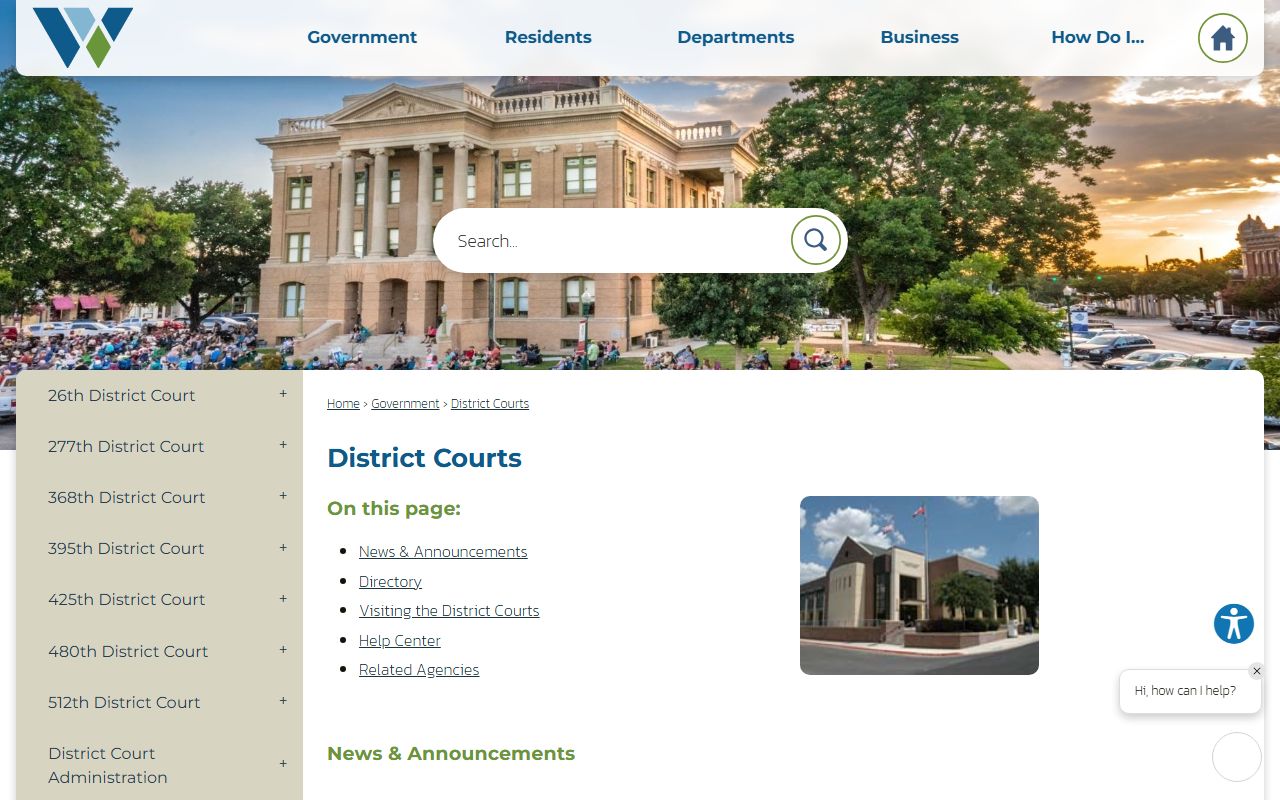
The page lists each district court, its judge, and links to find court dates and case information.
| Court | Judge | Main Jurisdiction |
|---|---|---|
| 26th District Court | Donna King | Civil and criminal; Felony Mental Health Docket |
| 277th District Court | Stacey Mathews | Criminal and juvenile; Transformative Justice Program |
| 368th District Court | Sarah Bruchmiller | Civil and criminal |
| 395th District Court | Ryan Larson | Civil, child welfare, family; Family Recovery Court |
| 425th District Court | Betsy Lambeth | Civil, child welfare, family; Family Recovery Court |
| 480th District Court | Terence M. Davis | Civil, child welfare, family |
| 512th District Court | Visiting Judge | Civil and criminal; new court funded in the FY25-26 budget |
All seven courts share the Justice Center at 405 Martin Luther King Street, Georgetown, with the District Clerk reachable at 512-943-1212 and the county line at 512-943-1100.
District Court vs. County Court vs. Justice Court
Texas spreads trial work across three levels. District courts take the most serious and complex cases. County Courts at Law handle mid-level matters. Justice of the Peace courts handle the smallest civil and criminal cases. The table below compares the three.
| District Court | County Court at Law | Justice / JP Court | |
|---|---|---|---|
| Civil Limit | Higher-value civil, no low cap | Over $500 up to $250,000 | Up to $20,000 |
| Criminal Jurisdiction | Felonies | Class A and B misdemeanors | Class C misdemeanors and traffic |
| Family Cases | Yes | Some, as assigned | No |
| Typical Jury Size | 12 | 6 | 6 |
How a Case Moves Through the Williamson County System
A case follows a set path, though the steps differ for criminal and civil matters. The diagrams below show the usual flow from start to appeal.
Criminal flow: Arrest › Magistrate / First Appearance › Indictment or Information › Arraignment › Pretrial › Trial › Sentencing › Appeal
Civil flow: Petition Filed › Answer › Discovery › Mediation › Trial › Judgment › Appeal
A felony case often starts with a magistrate at the jail, then moves to a grand jury for indictment before it reaches a district court. A civil case starts when a petition is filed and the other side answers. Many cases settle before trial, so a docket may show dismissals or agreed judgments rather than a verdict.
Civil, Family, and Criminal Dockets
The district courts split their work by subject. Some courts lean criminal, some lean civil and family, and several handle a mix. The county pages show which court carries which docket, and a few courts also run specialty programs tied to their caseloads.
Criminal dockets handle felony prosecutions, from charging through sentencing. Civil dockets handle lawsuits over the lower-court limit. Family dockets cover divorce, custody, support, and child welfare, with the 395th, 425th, and 480th courts carrying much of that work. Juvenile matters run through courts like the 277th. The District Clerk keeps the file for every one of these cases.
Felony prosecutions are brought by the District Attorney for the 26th Judicial District, led by Shawn Dick, whose office sits in the Justice Center. A person who cannot afford a lawyer may qualify for court-appointed counsel through the county's indigent defense process. The county's growth shows in the courts themselves: the FY25-26 budget funded staff for a new 512th District Court, a clear sign of rising caseloads. As more cases arrive, the county adds courts and staff to keep dockets moving.
Felony Mental Health Docket
The 26th District Court, led by Judge Donna King, presides over the county's Felony Mental Health Docket. The program serves people with serious mental illness, and often co-occurring substance use or developmental disabilities, who face felony charges. The county describes it as evidence-based and built on the problem-solving court model, with the goal of lowering repeat offenses and improving community safety.
The docket uses a Forensic Assertive Community Treatment team and trauma-informed care, along with proven curricula such as Motivational Interviewing and Cognitive Processing Therapy. You can read about the program on the county Felony Mental Health Docket page.
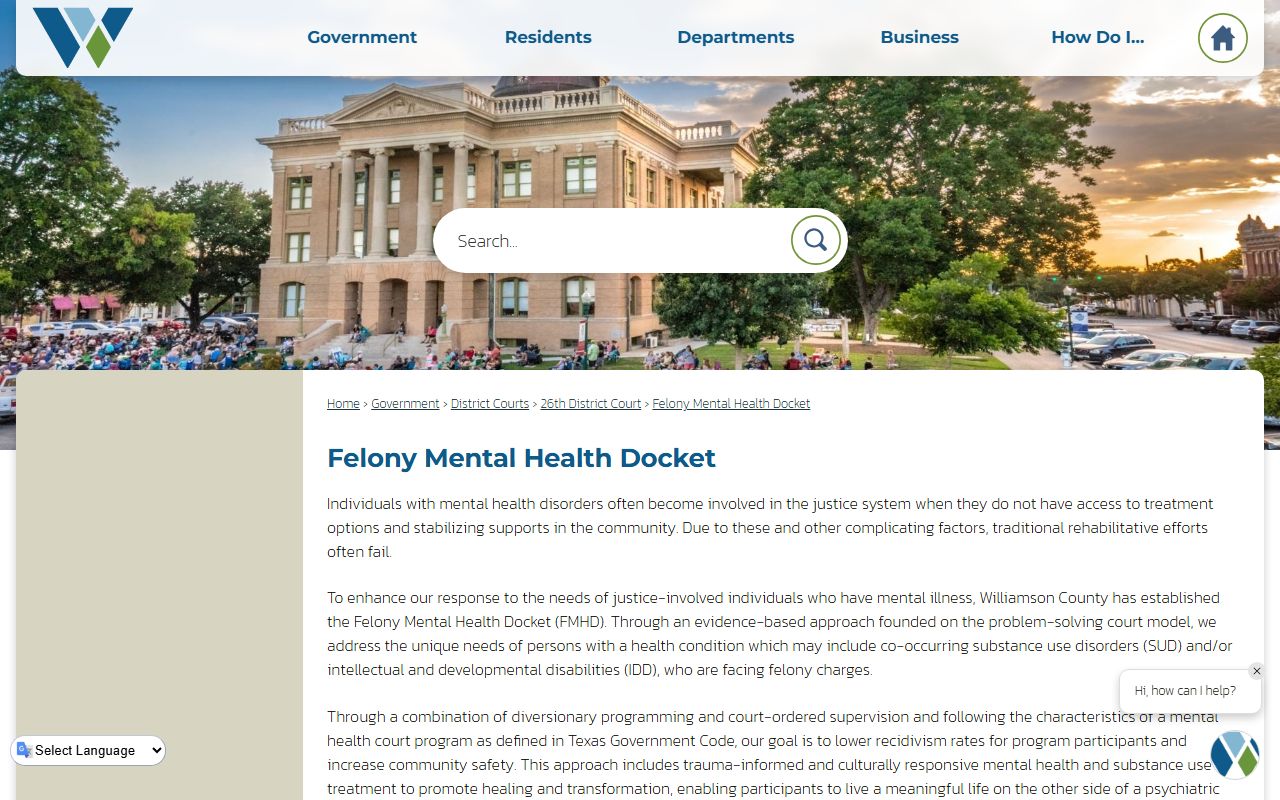
The docket is one of several specialty courts the county runs to address the cause of a case, not just the charge.
Magistrate and Lower Courts
Below the district courts sit the County Courts at Law, the Justice of the Peace courts, and city municipal courts. The County Courts at Law handle misdemeanors, probate, and mid-level civil cases. The four Justice of the Peace precincts handle traffic, evictions, small claims, and Class C cases. The county's Magistrate's Office, staffed by four associate judges, holds bail hearings at the jail seven days a week under Article 15.17 and reviews many warrants, including blood search warrants. A case may pass through more than one of these courts before it reaches a district court. A felony often begins with a magistrate at the jail, moves to a grand jury for indictment, and only then lands on a district court docket. Lower-court appeals, by contrast, may move up to a county-level court rather than straight to a district court.
Visiting a Williamson County District Court
The district courts sit in the Williamson County Justice Center at 405 Martin Luther King Street in Georgetown. The public enters at the corner of 4th Street and Martin Luther King Street, and the building is open weekdays from 8:00 AM to 5:00 PM. Security screening is required, and bags and packages are subject to search. The Sheriff's Office handles building security.
Plan ahead for a court day. The county lists free parking around the building, with the nearest options a surface lot on 4th Street just north of the Justice Center and a parking garage on 4th Street across from the jail. Recording court proceedings is barred by law, cell phones must be off or silent in courtrooms, and food and drink are not allowed. Children should not be brought without prior court approval, and court dress is formal, with no shorts, hats, or flip flops. Allow extra time to clear security again if you step out during a long docket day.
Federal Courts and Appeals
Some cases are federal, not local. Williamson County falls in the U.S. District Court for the Western District of Texas, Austin Division, which sits in Austin rather than at the county Justice Center. Federal cases include federal crimes, civil-rights claims, and federal-question civil litigation. You can learn about the federal trial court at the Western District of Texas site.
The Western District is the federal trial court that covers the county through its Austin Division.
Federal bankruptcy cases run through the U.S. Bankruptcy Court for the Western District of Texas, a separate court from the district court. You can reach it through the Western District Bankruptcy Court site.
Bankruptcy filings are handled here, not in the county district courts or by the District Clerk.
Appeals from the Western District go to the U.S. Court of Appeals for the Fifth Circuit, except for specialized matters. You can read about it at the Fifth Circuit site.
The Fifth Circuit is the federal appeals court for Texas, separate from the state courts of appeals.
Federal case records are not in the county clerk systems. Federal docket sheets and documents come from PACER, the federal courts' online access service, which charges per-page fees and requires an account. You can register at PACER.
PACER is the place to find federal filings, while county court records stay with the county judicial records system.
Common Williamson County District Court Questions
Two questions come up most often about the district courts.
How do I find which court has my case? Search the county judicial records system by name or cause number. The result shows the court assignment and the court date when one is set. Each numbered district court keeps its own docket, so the assignment tells you which judge and courtroom to expect.
Where do I get a copy of a district court ruling? Certified copies come from the District Clerk, not from the online docket. Use the clerk's record request form with the cause number and document type. Online docket views are for tracking; an official copy carries the clerk's seal and must come from the office.