
What Probate Covers in Williamson County
Probate is the court process for wills, estates, and the care of people who cannot act for themselves. It covers admitting a will, appointing an executor or administrator, settling debts, and distributing property. It also covers guardianship of a person or an estate when someone cannot manage their own affairs. The county describes probate as protecting the wishes, rights, and obligations of people regarding property when they cannot act because of death or incapacitating illness.
In Williamson County, probate runs through the County Courts at Law and the County Clerk. The County Clerk files, records, and maintains probate records, while a County Court at Law hears the cases. You can read about the county's process on the Probate page.
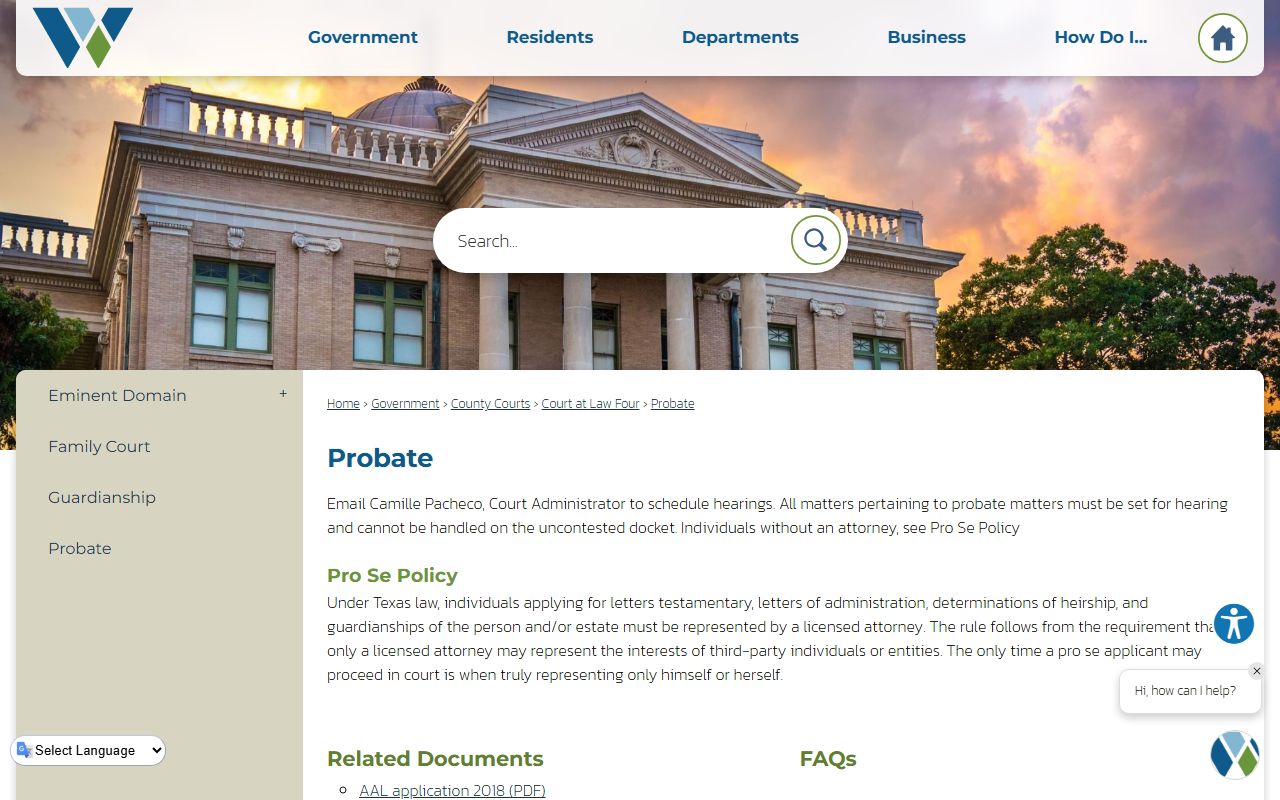
The probate page explains hearing scheduling, the pro se policy, and the forms the county uses. It is the best starting point before any estate or guardianship filing.
Probate Terms Defined
Probate uses words that rarely come up in daily life. A quick guide helps you read a file.
- Testator
- The person who made the will.
- Executor
- The person named in a will to carry out the estate.
- Intestate
- Dying without a valid will, which sends the estate through state distribution rules.
- Heirship
- A court finding of who the legal heirs are when there is no will.
- Guardianship
- A court appointment to manage the person or estate of someone who cannot.
- Conservatorship
- Court-supervised management of another person's affairs, used in some estate and care settings.
How to Search Williamson County Probate Records
Probate cases filed in a County Court at Law can be searched through the county's judicial records system, and file copies come from the County Clerk. You can open the lookup from the county Public Judicial Records page, and use the County Clerk's official records search for recorded documents.
- Open the judicial records system and choose a probate or County Court at Law search.
- Search by the estate, decedent, or ward name, or by a cause number if you have one.
- Open the case to view filings, then request file copies from the County Clerk.
The Attorney Requirement for Probate
Texas law limits who can file probate without a lawyer. Because applications for letters testamentary, letters of administration, determinations of heirship, and guardianships represent the interests of third parties, the applicant must be represented by a licensed attorney. A person may proceed without a lawyer only when truly representing just themselves. The county's probate page sets out this pro se policy clearly.
Hearings are required. The county says all probate matters must be set for a hearing and cannot be handled on the uncontested docket. Applicants schedule hearings through the court administrator. This is a key difference from a simple records request, and it is why many people retain counsel before they file.
How Probate Works in Williamson County
Probate follows a set path, though the details depend on the estate. The steps below outline a typical case from filing to closing.
- Decide which proceeding fits, such as full probate, a small estate affidavit, a muniment of title, an heirship finding, or a guardianship.
- Review the county's pro se policy, since most applications for letters, administration, heirship, and guardianship require a licensed attorney.
- File the application with the County Clerk, using e-filing when an attorney represents the estate.
- Set the hearing through the court administrator, because probate matters must be heard and cannot use the uncontested docket.
- Give the required notices and citations to interested parties.
- Attend the hearing, where the court may admit the will, appoint a representative, or make heirship or guardianship findings.
- File any required oath or bond, then file the inventory, appraisement, and reports, and close the estate after claims and distributions.
Probate Courts in Williamson County
Williamson County does not have a stand-alone statutory probate court. Probate and guardianship cases are heard in the County Courts at Law, with County Court at Law No. 4 handling probate, guardianship, and related dockets. The County Clerk keeps the records. The contact cards below show where to file and where to get copies.
County Courts at Law (Probate)
Williamson County Justice Center
405 Martin Luther King St., Georgetown, TX 78626
512-943-1515
Hearings set through the court administrator
Williamson County Clerk (Probate Records)
405 Martin Luther King St.
Georgetown, TX 78626-4901
512-943-1515
Courts (2nd floor): Mon-Fri 8am-5pm
Probate Filing Fees
The County Clerk sets probate filing fees on a separate schedule, including a recording fees document. The county materials here do not fix a current dollar amount for each probate filing, so confirm the figures with the County Clerk before you file. Certified copies follow the standard clerk copy rate. The table below shows the fee items and where to confirm amounts.
| Item | Amount |
|---|---|
| Original probate application | Set by County Clerk (confirm current fee) |
| Letters testamentary or administration | Set by County Clerk (confirm current fee) |
| Guardianship application | Set by County Clerk (confirm current fee) |
| Certified copy per page | $1 per page (standard clerk copy rate; confirm County Clerk schedule) |
Note: The County Clerk publishes a separate fee schedule and a recording fees document, so verify exact probate amounts before filing.
What Williamson County Probate Records Show
A probate file builds over the life of a case. It can hold the will, the application, citations and notices, letters testamentary or of administration, an inventory and appraisement, a list of claims, annual or dependent administration reports, and the court's orders. Guardianship files add reports on the ward and the estate. The Estates Code governs how wills are admitted and how estates are administered.
You can read the probate provisions in Texas Estates Code § 205, which covers small estate affidavits and related filings.
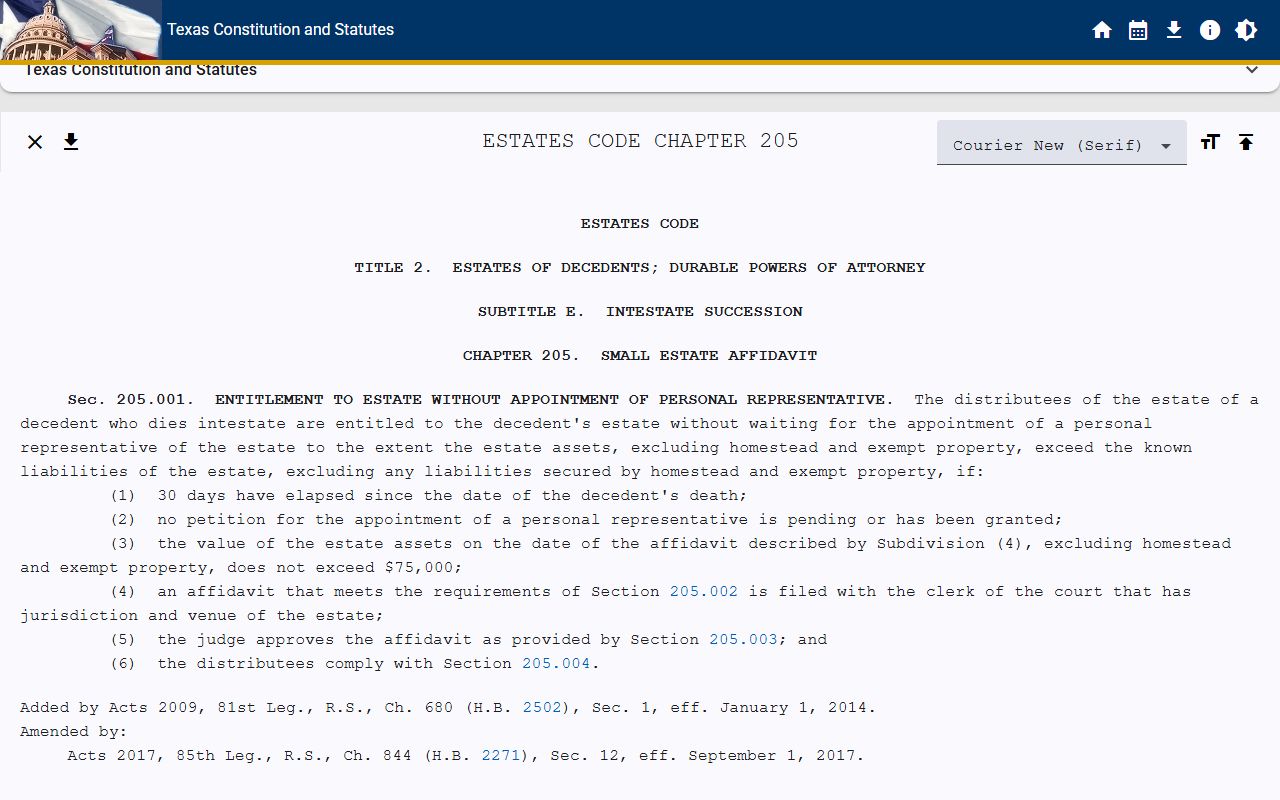
The Estates Code sets the tools families use, from full administration to a small estate affidavit for modest estates.
Reading a probate file takes some patience. Early documents show who applied and what they asked the court to do. Middle documents show the court's appointment of a representative and the estate's inventory. Later documents show claims, accountings, and the final distribution. A guardianship file follows a similar arc but centers on the ward's care and finances rather than a deceased person's estate.
Common Williamson County Probate Forms
The county lists several probate forms for filers. They support both full administration and simpler paths for small estates. Read the pro se policy first, since many applications still require an attorney.
- Small Estate Affidavit and its checklist, for qualifying modest estates.
- Descent and Distribution Worksheet, used to map heirs.
- Verification of Funds on Deposit, for certain estate matters.
- Annual reporting forms for dependent administrators.
The county's probate page links these forms along with general probate information. To schedule a hearing, the county directs applicants to email the court administrator.
Restricted Probate Records
Most probate filings are public, but some content is protected. Guardianship files can hold medical and mental-health information that is restricted by law. Records that identify a minor or a protected person may be withheld or redacted. Sealed matters and certain financial details are also limited. When a record is restricted, the County Clerk will not release it unless the law allows it. If you are a party or an interested person and need a closed record, ask the court how to request access, since the clerk cannot give legal advice on a sealed file.
Common Williamson County Probate Questions
Two questions come up most often from families starting a probate case.
Do I need a lawyer to probate a will? Usually yes. The county requires a licensed attorney for applications that affect third parties, including letters testamentary, administration, heirship, and guardianship. You may proceed without a lawyer only when you truly represent only yourself. A small estate affidavit can be simpler, but the county still sets its own requirements.
How do I get a copy of a probate file? Probate records are kept by the County Clerk. You can search a case through the judicial records system and request file copies from the County Clerk. Certified copies follow the clerk's copy rate, and restricted guardianship or mental-health content may be withheld.