
What Is a Court Docket in Williamson County
A docket is a dated log of everything that happens in a case. Each line marks an event, such as a petition filed, a motion set, a hearing held, or an order signed. It is not the full case file. The file holds the actual documents, while the docket is the index that points to them. Court staff use the docket to track a case from filing to final judgment, and the public can use it to follow along.
Williamson County splits dockets the same way it splits records. District court dockets cover felony, civil, family, and divorce cases. County Court at Law dockets cover misdemeanors, probate, and lower-level civil matters. Justice Court calendars cover traffic, evictions, and small claims. The District Courts page confirms the public site shows court assignment and a court date once a setting exists.
How to Find Williamson County Dockets Online
The county's Public Judicial Records site is the main place to look. County pages point to it for pending district cases, court assignment, and court dates, plus County Clerk judicial cases and Justice Court records. You can open it from the county Public Judicial Records page. Justice of the Peace precincts also link their own court calendars.
- Open the Public Judicial Records portal from the county Court and Jail Lookup link.
- Pick the court type that matches your case, such as district or County Court at Law.
- Enter a party name or a cause number to pull the case.
- Open the case and read the docket entries to find the next setting and recent events.
Justice of the Peace precincts handle their own calendars apart from the district system. Precinct 3, for example, links a court calendar that points to the judicial records site, and each precinct lists court records, fine amounts, and pay-online tools. If your matter is a ticket, an eviction, or a small claim, start with the JP precinct that issued the case rather than the district court search. Search by full legal name when you do not have a cause number, since names without a number can return several cases to sort through.
Sample Williamson County Docket Entry
Each docket line follows a simple pattern. It carries a date, the type of event, who filed it, and sometimes a link to the document. Reading a few lines tells you where a case stands. The table below breaks down the parts of a typical entry.
| Field | What It Shows |
|---|---|
| Entry Date | The date the event was filed or set on the calendar. |
| Event Type | The action, such as petition filed, hearing set, order signed, or judgment entered. |
| Party Filing | Which side filed the document or asked for the action. |
| Document Link | A link to the filing when the portal makes it available. |
Courts That Publish Dockets in Williamson County
Not every court posts the same way. District courts feed the public judicial records site for pending cases. County Courts at Law publish through the County Clerk's judicial case search. Justice of the Peace precincts keep their own court calendars and court records links. City municipal courts run on their own systems and are not part of the county portal.
- District Courts - pending felony, civil, family, and divorce cases on the public judicial records site.
- County Courts at Law - misdemeanor, probate, and civil dockets through the County Clerk.
- Justice of the Peace Courts - precinct court calendars for traffic, evictions, and small claims.
- Municipal Courts - city ordinance and city traffic dockets kept outside the county system.
The County Courts at Law page lists each court and its docket links. You can review the courts on the county County Courts at Law page.
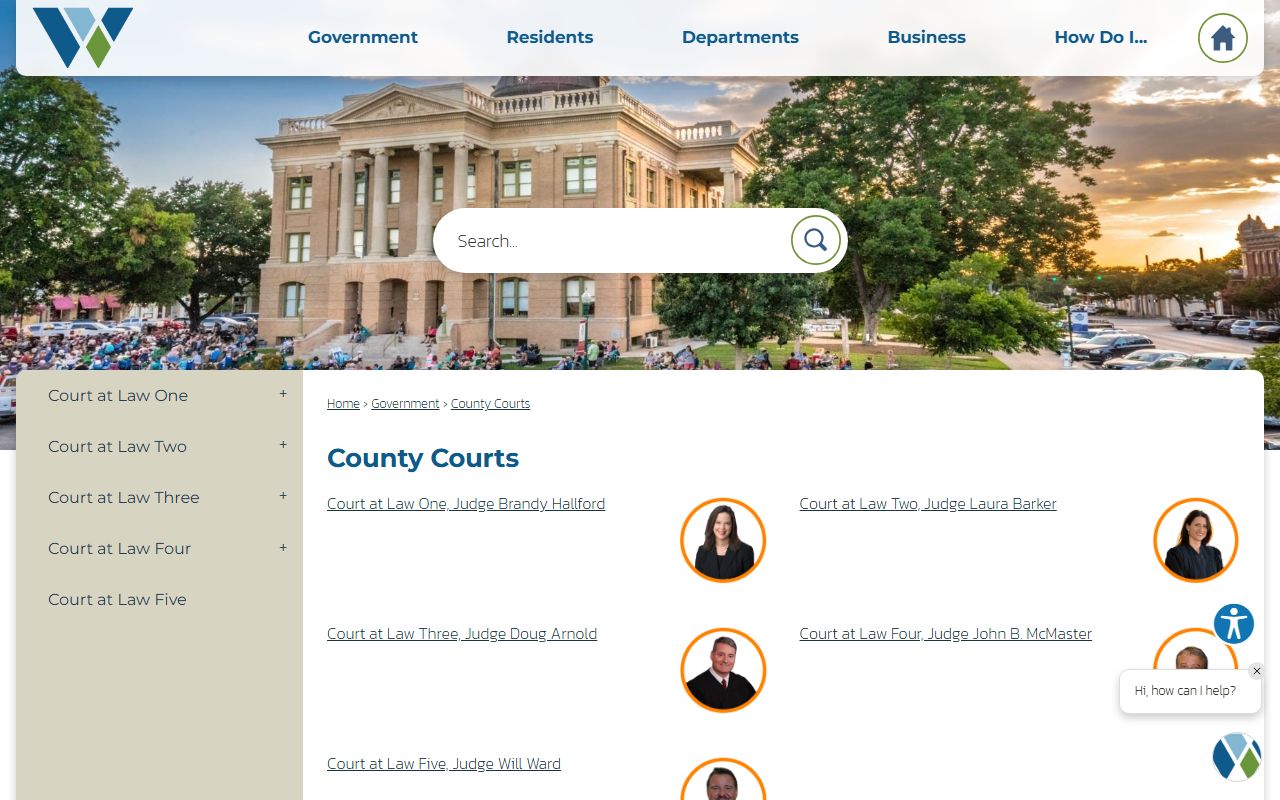
The page lists Courts at Law 1 through 5, their judges, and links to local rules and specialty dockets.
Williamson County District Court Dockets by Court
The county lists seven district courts, each with its own judge and docket focus. They all sit at the Justice Center in Georgetown and share the same public judicial records system. Knowing which court holds a case helps you find the right docket fast, since each court keeps its own calendar of settings and hearings. The table below shows the seven district courts and the kinds of cases each docket tends to carry.
| Court | Judge | Docket Focus |
|---|---|---|
| 26th District Court | Donna King | Civil and criminal; Felony Mental Health Docket |
| 277th District Court | Stacey Mathews | Criminal and juvenile; Transformative Justice Program |
| 368th District Court | Sarah Bruchmiller | Civil and criminal; Felony Treatment Court links |
| 395th District Court | Ryan Larson | Civil, child welfare, family; Family Recovery Court |
| 425th District Court | Betsy Lambeth | Civil, child welfare, family; Family Recovery Court |
| 480th District Court | Terence M. Davis | Civil, child welfare, family |
| 512th District Court | Visiting Judge | Civil and criminal; new court added in the FY25-26 budget |
The five County Courts at Law run their own dockets too, led by Judges Brandy Hallford, Laura Barker, Doug Arnold, John B. McMaster, and Will Ward. Those courts post misdemeanor, probate, and lower civil settings through the County Clerk. For full court contact details and jurisdiction, see the district court page.
Docket vs. Full Case Record
The docket is a list of events; the full case record holds the documents behind those events. You use the docket to track progress and find the next court date. You use the full file for the actual motions, orders, and judgments. Certified copies of documents come only from the clerk, not from the docket view.
| Docket | Full Case Record | |
|---|---|---|
| Format | List of entries | Full documents |
| Access | Often online and free | May require a copy fee or visit |
| Use | Track case progress and dates | Legal review and certified copies |
How to Read a Williamson County Docket
Docket lines lean on short terms. A petition or complaint starts a case. A motion asks the court to do something. An order is the judge's signed directive. A disposition is the result, such as dismissed or disposed. A continuance is a postponement of a setting. Watch the dates closely, because the most recent lines tell you the current status.
Criminal dockets add their own words. An indictment is a grand jury's felony charge, and an arraignment is the setting where a defendant answers the charge. A capias is an order to take a person into custody. None of these terms decide guilt; only the final judgment does that. For criminal case tracking, see the arrest records page.
Courtroom Rules for a Williamson County Docket Day
If your docket date means a court appearance, plan for the Justice Center rules. The public enters at 4th Street and Martin Luther King Street, and security screening is required. Recording court proceedings is barred by law. Cell phones must be off or silent and may not be used in the courtroom. Food and drink are not allowed in courtrooms. Children should not be brought without prior court approval.
Note: Court dress is formal; the District Courts page lists long pants or a dress, with no shorts, hats, or flip flops.
Continuances, Settings, and Missed Court Dates
A setting is the date and time the court schedules an event. A continuance moves that setting to a later date. Dockets change often as cases get reset, so the date you saw last week may not hold this week. Check the docket again close to your hearing, and confirm with the court coordinator if the entry is unclear. Court staff can answer general scheduling questions but cannot give legal advice.
Missing a court date carries real risk. Depending on the case, it can lead to a warrant, a bond forfeiture, a default judgment, or a dismissal. If you miss a date, contact the court or clerk right away. Be careful with scam calls too. The District Clerk warns that county courts will never call and demand money or gift cards to clear a failure-to-appear jury warrant. For warrant questions, see the warrant records page.
Common Williamson County Docket Questions
A few questions come up often when people first search a docket. Short answers help you act on what you find.
Why does my case show no court date? A court date appears on the public site only after the court sets one. New filings and cases between settings may show recent docket events but no upcoming hearing. Check back as the case moves, or call the court coordinator to confirm the next step.
Is the docket the same as a certified record? No. The docket is a free public list of events. A certified copy is an official document with the clerk's seal, and it must come from the District Clerk or County Clerk. Online docket views are for tracking, not for proof in another court.