
How to Search Williamson County Court Records
The main online tool is the Williamson County Public Judicial Records site. County pages point to it for District Court pending cases, court assignment, court dates when set, Justice of the Peace records, County Clerk judicial cases, and jail records. It is the same system the county labels as its Court and Jail Lookup. The District Courts page states the site holds information on all cases pending in the district courts, except records restricted by law. For official documents you still go to a clerk.
Before you start, know which court has your case. Have a full legal name or, better, a cause number. A cause number is the unique case ID a clerk assigns when a case is filed. Marriage records, misdemeanors, and probate live with the County Clerk. Felony, divorce, and higher civil cases live with the District Clerk. Traffic and small claims sit in the Justice Courts.
The county opens the portal through its main site. You can reach the official lookup from the Williamson County Public Judicial Records page.
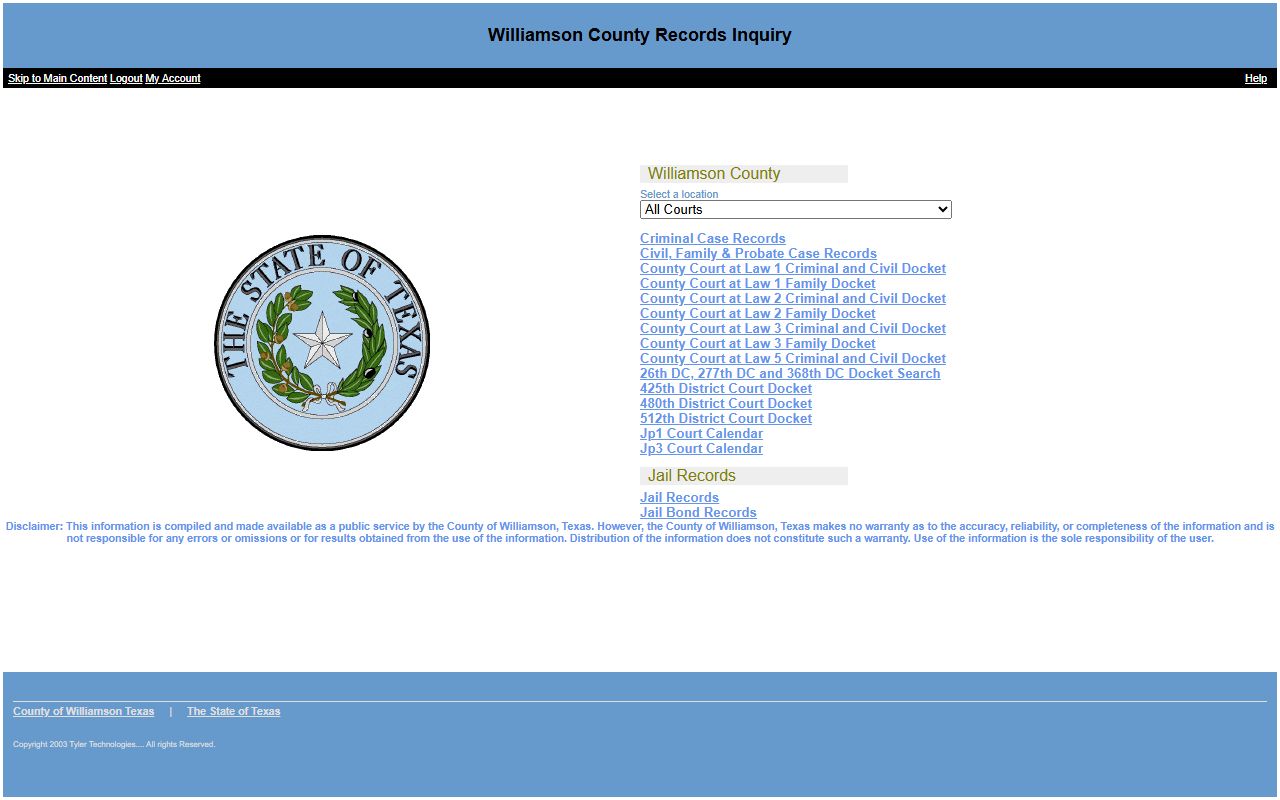
This portal is the county-identified home for court and jail searches, so it is the right first stop for most case lookups.
- Pick the right custodian first. Use District Clerk or Judicial Records for felony, civil, family, and divorce cases. Use the County Clerk for misdemeanors, probate, and marriage. Use the Justice Courts for traffic, evictions, and small claims.
- Open the Public Judicial Records site and choose a search by party name or by case number.
- Search by full legal name when you do not have a cause number, or enter the cause number when you do.
- Narrow by court type or court date if the portal offers those filters, then open the case to read the docket.
- Request a certified copy from the proper clerk if you need an official document. Certified copies are not emailed.
The Williamson County Judicial System
Texas uses a layered trial-court structure, and Williamson County fits it closely. District courts are the general-jurisdiction courts. They hear felonies, higher-value civil suits, divorce and family matters, juvenile cases, and child welfare cases. County Courts at Law sit just below them and handle Class A and Class B misdemeanors, civil cases within set dollar limits, probate, and guardianship. Justice Courts are the first stop for many residents. They take Class C misdemeanors, traffic tickets, evictions, and small claims. Municipal courts handle city ordinance and city-filed traffic cases.
Appeals move upward. Most Williamson County civil and criminal appeals route to the Third Court of Appeals in Austin. Final civil review rests with the Supreme Court of Texas, and final criminal review rests with the Texas Court of Criminal Appeals. A ticket from a city police officer may end up in a municipal court, not a county court, so a Round Rock or Georgetown city ticket can be missing from a county case search.
Case flow: Justice Court › County Court at Law › District Court › Court of Appeals
| Court | Jurisdiction | Case Types |
|---|---|---|
| District Courts | General jurisdiction | Felonies, higher civil, divorce, family, juvenile, child welfare |
| County Courts at Law | Limited jurisdiction | Class A/B misdemeanors, civil over $500 up to $250,000, probate, guardianship |
| Justice Courts | Precinct level | Class C and traffic, evictions, small claims up to $20,000, inquests, warrants |
| Municipal Courts | City level | City ordinance and city-filed traffic and Class C cases |
The Justice Courts page lays out each precinct and its duties. You can review precinct jurisdiction on the county Justice Courts page.
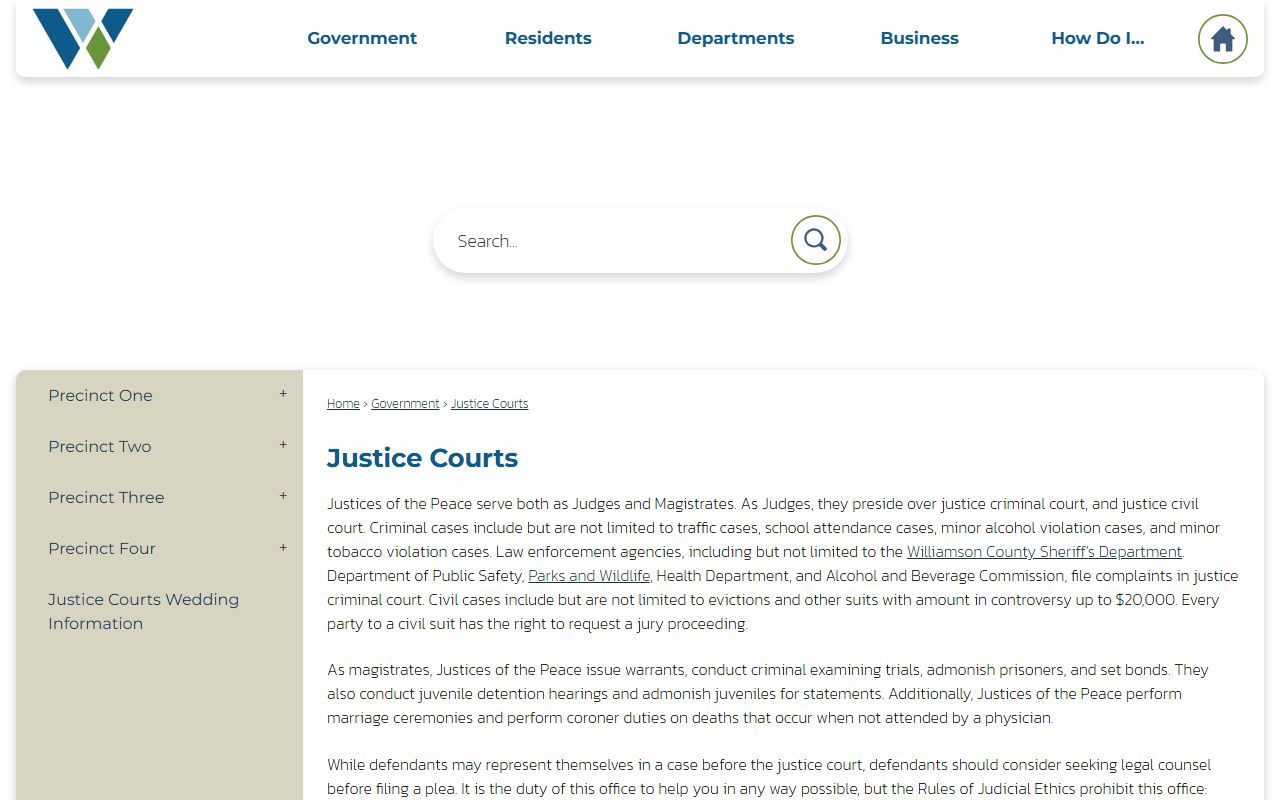
Four Justice of the Peace precincts serve the county, and each one links its own court records, calendar, and pay-online tools.
Williamson County Courthouses
The Williamson County Justice Center at 405 Martin Luther King Street in Georgetown is the main court-record destination. It houses the district courts, the County Courts at Law, the District Clerk, County Clerk court functions, the Magistrate's Office, and the District Attorney. The public entrance is at the corner of 4th Street and Martin Luther King Street. The building is open to the public Monday through Friday from 8:00 AM to 5:00 PM. The historic courthouse on the Georgetown square is a landmark, but court records run through the modern Justice Center.
Williamson County Justice Center
405 Martin Luther King Street
Georgetown, TX 78626
512-943-1100
District Clerk's Office
405 Martin Luther King St. (P.O. Box 24)
Georgetown, TX 78626
512-943-1212
County Clerk's Office
405 Martin Luther King St.
Georgetown, TX 78626-4901
512-943-1515
The county's main site ties these offices together with online services and a quick Court and Jail Lookup link. You can start from the Williamson County government homepage.

From this homepage you can reach records, court lookups, news, and the general county phone line.
Types of Court Records Available in Williamson County
The county produces many record types because so many courts feed the system. Felony case files come from the district courts. Misdemeanor files come from the County Courts at Law. Family and divorce files, plus juvenile and child welfare matters, run through the district courts. Probate, guardianship, and marriage records sit with the County Clerk. Justice Courts add traffic, eviction, and small-claims files.
Which court made the record decides which clerk holds it. That is why one person may need both clerks for two different cases.
- Criminal records - felony files from the district courts and Class A/B misdemeanors from the County Courts at Law.
- Civil records - lawsuits, judgments, and other civil matters split by dollar amount between district and county courts.
- Family and divorce records - divorce decrees, custody, support, and child welfare cases kept by the District Clerk.
- Probate records - wills, estates, letters, heirship, and guardianship kept by the County Clerk.
- Traffic records - citations and Class C cases in the Justice Courts or in a city municipal court.
What Williamson County Court Records Show
A public case record usually lists the cause number, the court it sits in, the parties, and a running list of events called a docket. The District Courts page confirms the public site shows court assignment and a court date when one is set. Documents themselves may be open, redacted, or available only by a clerk copy request. Sensitive data such as Social Security numbers and driver license numbers is commonly removed.
| Field | What It Shows |
|---|---|
| Case Number | The unique cause number the clerk assigns to the case. |
| Filing Date | The date the clerk accepted the case or document. |
| Parties | Plaintiff and defendant in civil cases; the State and the defendant in criminal cases. |
| Charges / Cause | The charge and statute in a criminal case, or the claim in a civil case. |
| Disposition | The current or final result, such as dismissed, disposed, or transferred. |
| Sentence / Judgment | The court's final decision, including any sentence or money judgment. |
Public Access Laws for Williamson County Court Records
Texas does not use one single rule for every record. Government office records fall largely under the Texas Public Information Act. Court case records are held by the judiciary and follow court rules, statutes, and clerk practices instead. Criminal-history release is governed by its own DPS rules. So a request to a county department is not the same as a certified-copy request to a clerk. Many personal identifiers are redacted by law before a record is shown to the public.
Key Statutes:
Texas Government Code § 552 - the Public Information Act; it makes government records open during business hours unless an exception applies.
Texas Government Code § 411 - sets criminal-history rules and orders of nondisclosure that seal records from the public but not from all agencies.
Texas Code of Criminal Procedure § 55 - governs expunction, the order that removes eligible arrest and court records.
Records That Are Restricted or Confidential
Some records never show up in a public search. Juvenile records, adoption files, and sealed civil records are closed by statute or court order. Expunged records are removed, and records under an order of nondisclosure are hidden from public view. Mental-health and medical records, grand jury matters, and victim-identifying data in family violence or assault cases are also protected. The District Clerk's request form states that documents sealed by order or statute will not be released unless the law allows it.
To view a sealed record you usually must be a party, an attorney of record, or an authorized agency. If none of those fit, you may need a court order. The clerk cannot give legal advice, so a person seeking sealed records often needs an attorney to file the right motion.
Specialty Courts in Williamson County
Williamson County runs several specialty dockets that aim to cut repeat offenses and treat the cause of a case. The Felony Mental Health Docket in the 26th District Court serves people with serious mental illness who face felony charges. It uses a Forensic Assertive Community Treatment team, trauma-informed care, and proven curricula such as Motivational Interviewing and Cognitive Processing Therapy. The county describes the docket as evidence-based and built on the problem-solving court model.
You can read more about these programs on the county Specialty Court Programs page.
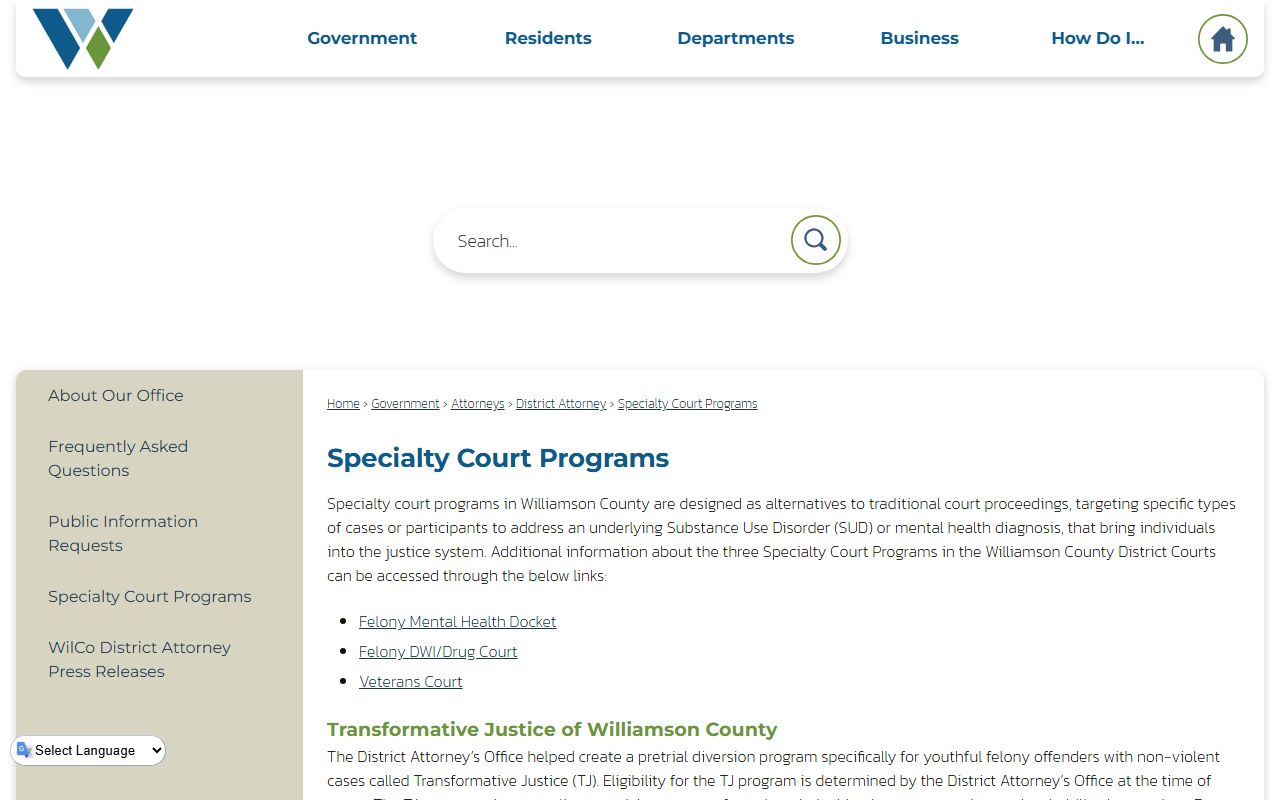
The page gathers the county's problem-solving courts in one place, from felony dockets to youth programs.
Other programs reach across the system. The 395th and 425th District Courts preside over the Family Recovery Court for child welfare cases tied to substance use. County Court at Law No. 2 links to a DWI Drug Court, a Mental Health Court, and a Veterans Court. Justice of the Peace precincts run Teen Court, where teens serve as attorneys, jurors, and bailiffs in peer-led hearings for minor youth cases. The county shared its latest Teen Court results in a recent county news update.
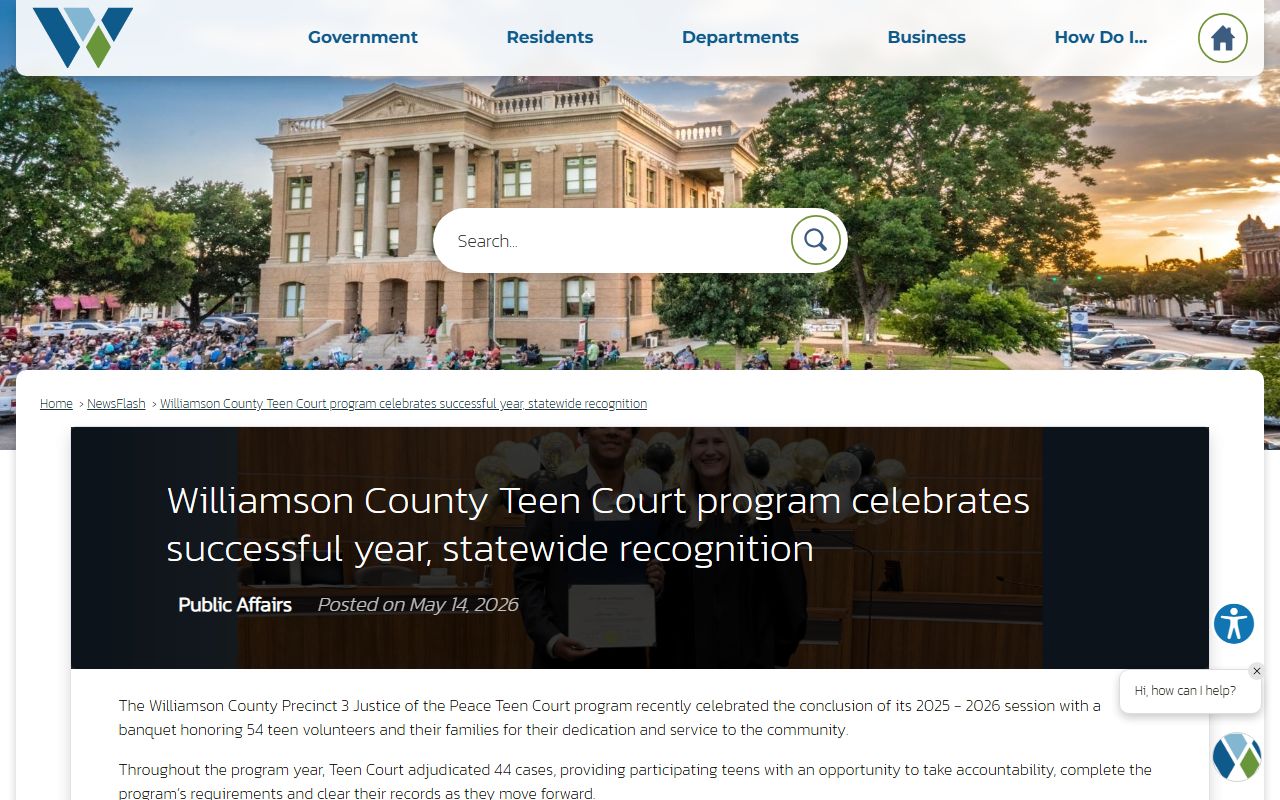
The county reported that JP3 Teen Court handled 44 cases and honored 54 teen volunteers in its 2025-2026 session.
In late 2025 the county also launched Multisystemic Therapy through Juvenile Services for youth ages 12 to 17. The state's court system keeps a wider registry of these programs. The Texas Judicial Branch specialty courts page sets the statewide context.
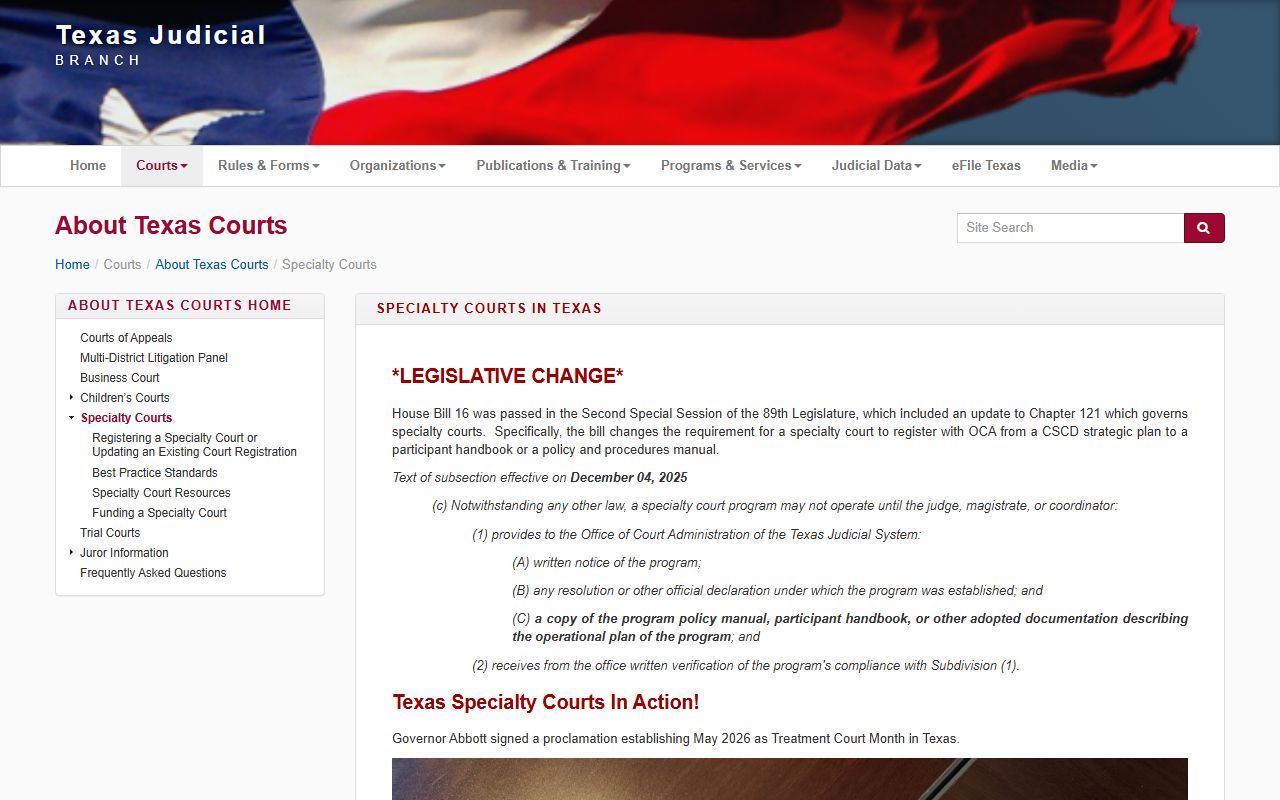
Statewide oversight helps these local dockets follow uniform standards and report their results.
Williamson County Sheriff and Jail
The Williamson County Sheriff's Office runs the county jail through its Corrections Bureau. Sheriff Matthew Lindemann leads the department. The jail has bed space for 1,104 inmates and holds a daily population of about 600. To look up jail records, the county says to search by first and last name or by booking number in the Williamson County Records Inquiry. The same Public Judicial Records system covers both court and jail lookups. You can review jail operations on the county Corrections Bureau page.
For the full roster, booking details, and visitation rules, see the Williamson County inmate records page. For active warrants and how to clear one, see the warrant records page.
Marriage, Divorce, and Probate Records
Marriage and probate records sit with the County Clerk, who is the local registrar for birth, marriage, and death. Divorce records are district court files kept by the District Clerk. So a couple's marriage license and their later divorce decree live in two different offices. For details and fees, see the marriage and divorce records page and the probate records page.
- Testator
- The person who made a will.
- Executor
- The person named in a will to carry out the estate.
- Conservator
- A person the court appoints to manage another person's affairs, often called a guardian in Texas probate.
Williamson County Court Records Fees
The District Clerk sets clear copy fees on its record request form. Paper copies, whether plain or certified, cost the same per page. Electronic copies use a tiered rate. The office does not accept American Express or personal checks, and credit card payments carry added fees. The County Clerk keeps a separate fee schedule for its records. You can confirm current figures with the District Clerk's office before you pay.
| Item | Amount |
|---|---|
| Plain (non-certified) paper copy | $1 per page |
| Certified paper copy | $1 per page |
| Non-certified electronic copy | $1 for up to 10 pages, then $0.10 per added page |
| Credit card convenience fee | $2 per transaction ($5 minimum service fee) |
How to Interpret Williamson County Court Records
Reading a case record takes some care. An arrest or a charge is not a conviction. A charge is only an accusation; the disposition tells you the result. Watch for terms like dismissed, deferred adjudication, and capias. Deferred adjudication is a form of community supervision where the court holds off on a finding of guilt. A capias is an order to take a person into custody, and a capias pro fine ties to an unpaid fine. If a record looks wrong or out of date, call the clerk who holds it before you rely on it.
Accuracy and Record Limitations
Online records can lag behind the courthouse. The District Clerk processes e-filings during business hours, usually within 24 to 48 hours. Copy requests may take up to three days. New filings, sealed matters, and clerk review can all delay what the public sees. Court dates and assignments appear on the public site only once they are set. None of this means a record is wrong, just that the file at the clerk's office is the controlling copy.
Note: Always confirm a case detail with the District Clerk or County Clerk before you act on it, because online records may not reflect the latest filing.
History of Williamson County Courts
Williamson County was created in the 1840s, and Georgetown has long served as the county seat. The County Clerk's office is one of the oldest state offices, set in Texas in 1836, and the Texas Constitution still requires an elected county clerk for each county. As the county grew north of Austin, its courts grew with it. The county now lists seven district courts, five County Courts at Law, four Justice of the Peace precincts, and a set of specialty dockets.
That growth shows in the budget. The county's 2025-2026 budget added staff for a new 512th District Court, plus deputies and corrections officers. You can read the budget news on the county FY25-26 budget update.
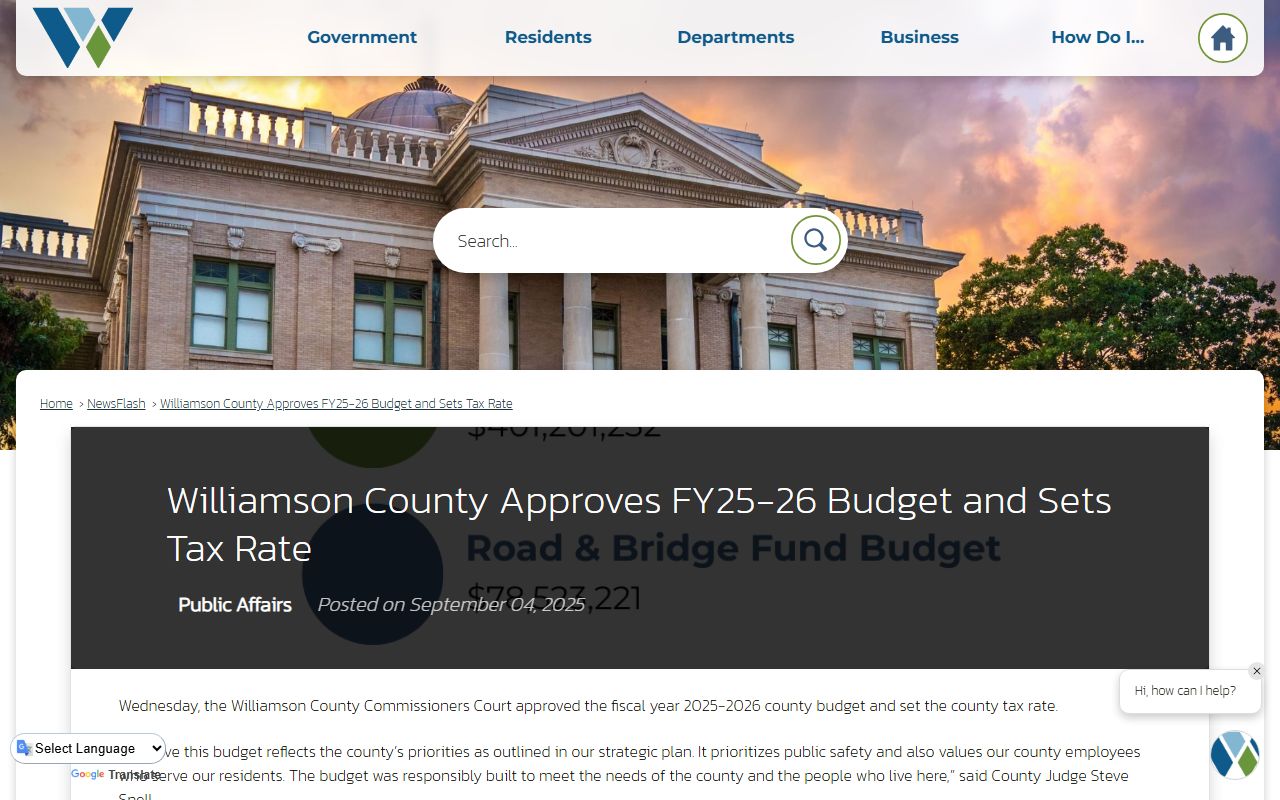
The new 512th District Court is a clear sign of rising caseloads and population pressure in the county.
Technology changed the system too. Civil e-filing started in 2014 and criminal e-filing in 2018. The jail moved regular inmate mail to an electronic scanning service in 2022. Youth programs have drawn statewide notice, including a countywide Teen Court competition. See the county's Teen Court competition news for more.

Several precincts and a city municipal teen court took part, a sign of how youth diversion has spread across the county.
Frequently Asked Questions
How do I search Williamson County court records?
Start with the Williamson County Public Judicial Records site for court dates, court assignment, and case information in pending district cases, and for the court and jail lookup links. Use the County Clerk search portals for official public records, marriage, misdemeanor, and probate files. Use the Justice Court precinct links for traffic, eviction, and small-claims matters. If you need a certified copy, go to the District Clerk or County Clerk rather than relying only on the search portal.
Which clerk has my record?
The District Clerk keeps district court files, including felony, civil, family, and divorce cases. The County Clerk keeps official public records, marriage and vital records, probate, County Court at Law civil cases, and Class A and B misdemeanors. The Justice Courts keep their own civil, eviction, traffic, and warrant records. City cases stay in municipal court. Match the court to the clerk and your search gets much faster.
Where do I search jail records?
The Corrections Bureau tells the public to search jail records by first and last name or by booking number in the Williamson County Records Inquiry. That is the same court and jail lookup system the county runs. The record may show booking and custody details, charges, bond, and release status. Exact fields can vary, so confirm details with the Sheriff's Office if the online status is unclear.
More on the Williamson County Court Records FAQ page.